Showing posts with label Location Profiles. Show all posts

Tuesday, January 21, 2014

Circumnavigation of Uruguay

By Jamie Douglas

Most of my readers no doubt are aware that Uruguay is an autonomous country lodged between the butt cheeks of Argentina and Brazil. But many of you may not realize that the country is literally surrounded by water. There is 660 km of coastline along the Atlantic Ocean and the Río de la Plata estuary, and thence up the Río Uruguay to Brazil, and from there heading southeast along the Brazilian border to Chuy and Barra del Chuy on the Atlantic Ocean coastline.

Along the Brazilian border there are miles upon miles of rivers separating the two nations, with the major towns from west to east being Bella Unión, Artigas, Rivera, Río Branco and, after the border passes through Laguna Merín, you finally end up in Chuy, 985 km from the Argentina-Brazil-Uruguay triple border.

Should you feel adventurous, you can circumnavigate the entire country on mostly good roads. (Please invite me along!)

You might first visit the well-preserved historic old town of Colonia del Sacramento, and after a couple of days of marveling at the beauty of this lovely UNESCO Heritage Site, head north through Mercedes, Paysandú and Salto, where you can relax in hot springs that have existed for centuries.

After your soak, head west to Artigas, where you are likely to run into some of the finest amethyst the world has to offer. Now comes the relatively uninhabited stretch to Rivera, then down to Vichadero and onto a dirt road to Melo. A disclosure here: My editor/wife and I were in Tacuarembó , which is in the interior of the country south of Rivera, a couple of years ago; and when we mentioned that we were going to book passage to Melo, people looked at us very strangely and wanted to know why we wanted to go there. They stated that there was nothing there, nothing to do, and the road was terrible. We believed them and returned to Montevideo, instead – the road from Paysandú to Tacuarembó was bad enough! After settling in La Paloma, we made new friends with our neighbors who had just moved from Melo. They assured us that it was not worth the time or energy to visit.

If you are truly adventurous, you can go from Melo to the border-crossing town of Río Branco and then head to Treinta y Tres, the city named after Uruguay’s 33 Founding Fathers, before making your way on backroads to Chuy. Alternatively, you could go straight to Treinta y Tres via highway. You will be well off the beaten path, either way.

The Beaches of Rocha

The department of Rocha reaches along the Atlantic Coast from the Brazilian border all the way to the department of Maldonado, almost to Punta del Este, the “Miami Beach” of Uruguay. It is a 200-mile stretch of uninterrupted sandy beaches, lagoons and rather primitive villages with inexpensive cabins right on the beach. After Barra del Chuy, you will come to a string of charming little place: La Coronilla, Santa Theresa National Park, Punta del Diablo, Aguas Dulces, Punta Castillos, Punta Aguada and Cabo Polonio National Park, where you have to park your car and take a giant WWII-era six-wheel-drive monster truck out to the cape.

Cabo Polonio has recently been designated a national park, and new construction is prohibited. But there is an abundance of illegally built houses (?) covering the sand dunes, some of them very rustic, ramshackle huts, while others are quite nice. Accommodations even in the high season (December through early March) are easy to get and are relatively economical. There is no electricity except for the lighthouse, and water has to be trucked in, so it is very limited.

There are several decent restaurants and a “supermarket” for your convenience, stocking everything you might need to cook your own food. An overabundant choice of wine and beer is also available in mass quantities.

Further south is a real town – with paved roads and all. La Pedrera is famous for its carnival and is a favorite with the young crowd, while La Paloma a few kilometers farther to the south has a little more of a family vibe.

La Paloma is a small city with about 3,000 year-round inhabitants (including us!), paved streets, running water and really expensive electricity. We have untold numbers of restaurants during the season and about a half dozen or so that stay open out of season.
During the high season, La Paloma serves as a vacation destination for about 30,000 people, and the beaches get quite crowded. Our Argentinean friends drive on residential streets as if they are on the highway – they are reckless and arrogant, just like they drive in Argentina.

Between La Paloma and Punta del Este, you have to briefly return to the main highway (Route 9) for a few kilometers until you come to a turnoff about 20 km from Rocha that will take you to the coastal highway to Punta José Ignacio, Punta Manantiales, La Barra and finally to Punta del Este. From there, many small roads branch off that follow the coast back to Montevideo that will take you along the brown, muddy waters of the Río de la Plata – or, you can take the Ruta Interbalnearia, the “inter-resort” toll road.

Enjoy the ride, and remember that the entire Atlantic coastline is one giant sand dune that is ecologically very sensitive. Tread lightly please!

Jamie Douglas
At large in Uruguay

I encourage you to write me at cruzansailor [at] gmail [dot] com with any questions or suggestions you may have. Disclaimer: I am not in any travel-related business. My advice is based on my own experiences and is free of charge (Donations welcome). It is always my pleasure to act as a beneficial counselor to those who are seekers of the next adventure.

Parada en Paysandú, Uruguay

article from July 23, 2012
by Julie R Butler

After driving for five days (at a leisurely pace) from San Rafael, Mendoza, to the Cataratas de Iguazú in the northeastern reaches of Argentina, then selling our car and riding the overnight bus to Colón to be dropped off on the side of a four-lane divided highway at the first light of dawn on a chilly Sunday morning, we took a taxi through the border crossing into Uruguay and on into the center of Paysandú, landing at the lovely Hotel El Jardín, where a warming fire, a fresh pot of coffee, and a serviceable staff made us feel comfortable and happy to be back to lil’ ol’ Uruguay once again.

The day was cloudy and gray and the mess of a big construction project on the main street of the city dampened the mood a little (they are installing fiber optics and putting all of the utilities under the sidewalks, which were greatly in need of repair, anyway). But after walking about and getting oriented, we found ourselves in a noisy pizza place that was full of soccer fans watching the World Cup qualifying match between Uruguay’s beloved team – known as La Celeste, the sky-blue color in the first flags of Uruguay and the team uniforms – and Peru. The pizza was great, plus we caught the dramatic, game-clinching goal and were a part of the thunderous celebration that it elicited. It was not a bad way to start things off.

Over the next few days, the weather brightened up as we explored the city. Happily, even though we didn’t know what exactly the Monument a Perpetuidad might entail, we wandered into this beautiful historic cemetery that features exquisite sculpture on par with what can be found in the famous Recoleta Cemetery in Buenos Aires except that this memorial garden is much less crowded and very tranquil. The remains of the scientists and philanthropists, the housewives, children, and common men “who forged the Paysandú of today” rest peacefully here, and their memories are honored with amazing marble artwork by Italian masters of the day.

The third-largest city in Uruguay, Paysandú is a commercial and industrial center as well as a tourist destination, with attractive beaches and plenty of open park space on the Uruguay River along with the nearby thermal springs. The city is known for the weeklong beer festival that is held during the Easter holidays (it’s officially called Semana Turismo in Uruguay) and its Carnival season celebrations.

Paysandú has rich historical significance for the Eastern Republic, having begun as an attempt at becoming one of the Jesuit missions (known as reducciones de indios) that were set up throughout the Río de la Plata Basin beginning in the seventeenth century. It was located at a cattle crossing of the Uruguay River and soon became established as a port known for its leatherworks and beef jerky plant. The jerky was once popular with the Portuguese as inexpensive sustenance for their African slaves, while the leather from Paysandú is still prized to this day. The wool fabrics produced here are also prized, and the other main industries are forestry products, citrus, cement, and beer. Paysandú is probably most famous within Uruguay for the heroic defense of its outnumbered inhabitants against Brazilian invaders in 1865 – a common theme in this tiny country.

We learned all kinds of interesting information in the modest history museum, and everywhere we went in the city, people were proud to point out the many historical buildings and monuments.

Photos by Jamie Douglas and Julie R Butler:


Julie R Butler is a writer, journalist, editor, and author of several books, including Nine Months in Uruguay and No Stranger To Strange Lands (click here for more info). She is a contributor to Speakout at Truthout.org, and her current blog is Connectively Speaking.
email: julierbutler [at] yahoo [dot] com, Twitter: @JulieRButler

Our Trip to Minas, Uruguay, Part Two

article from July 9, 2012
By Jamie Douglas

Minas, a charming town located in the sierras of Uruguay, has held an attraction for us for some time now, and we recently went there in search of housing for the near future – in vain, unfortunately.

Nevertheless, I highly recommend a visit to this small city in the “mountains” of Uruguay. There are various direct bus services from Montevideo, Piriápolis and Punta del Este. The ride is about one and a half hours from any of those places. If you are coming from the central or northern Atlantic coast, there is a shortcut by taking the bus to Pan de Azúcar and walking a block to the COOM “office,” a stale, rundown bar inhabited by strange creatures at all hours of the day. A bus leaves from there at noon. This bus schedule information website offers the details on most services available in the country in English.

So we took the ride from the stinking bar up to Minas, an incredibly clean town with 25,000 mostly friendly people and clean air that is surrounded by lovely rolling hillsides. The town itself features just about anything your heart might desire: well-stocked stores, restaurants and confiterías featuring world-class coffee and a great assortment of pastries, as well as several very nice hotels. Our favorite is the Posada Verdún, located at 715 Washington Beltran, just a couple of blocks from the bus station, in the heart of town. The posada features its own dining room, which serves world-class food at very affordable prices, and the chef’s pride is his bread. Judging by his waistline, he eats there, as well. All the rooms are well appointed and heated/air conditioned. We have been to this particular location several times, and they really do treat us like family. Their motto is “Su casa en Minas.”

Walking around town, we were constantly amazed at how clean everything was, how many smiling faces we encountered and, even late at night, how safe we felt. The little city just does not give off the aura of fear and crime that you encounter in so many other Latin American cities.

Another thing that was very pleasing to the eye was the architecture. With a couple of newer exceptions, all the buildings are no more than two stories, with many polychromatic fronts. The entranceways are tall and feature very ornate doors, most lacking iron grates.

The town features several well-groomed parks, the largest of which is right in the center of town, with a large statue of General Lavalleja sitting on his horse (with the occasional pigeon pooping on his chapeau). There are several vacation parks just outside of town, the best known of which is probably the Parque Salus, the source of the mineral water of the region as well as the local beer, Patricia, which recently got gobbled up by the Belgian multinational Ambev, then Inbev, the company that bought out Anheuser-Busch and Corona Modelo and is looking to become the world beer monopoly.

It is nevertheless a very nice excursion to go there. An ancient bus takes you the 10 kilometers from the Minas bus station to the nature park, where you will enjoy an abundance of eucalyptus and pine trees.

Other local attractions include the retreat village of Villa Serrana, 25 km northeast of Minas; Parque Artiguas, with its huge statue of the Uruguayan national hero, José Gervasio Artigas, on his horse; and many nature attractions in the surrounding mountains that offer outdoor activities such as fishing, camping and hiking.

Overall, Minas is a lovely destination for a few days or a weekend, but if you want to move there, there really is not much available in rentals. There are plenty of properties for sale, of course, whether you want to be in town or on the outskirts. So if you are in this neck of the woods, by all means, stop by in Minas and enjoy the easygoing town in the sierras, 500 feet above sea level, one of the higher places in Uruguay.

see also: Uruguay's "Secret": Minas and Our Trip to Minas, Uruguy: Part One

Jamie Douglas
About to be homeless (again) in Uruguay

[All photos by Jamie Douglas]

I encourage you to write me at cruzansailor [at] gmail [dot] com with any questions or suggestions you may have. Disclaimer: I am not in any travel-related business. My advice is based on my own experiences and is free of charge (Donations welcome). It is always my pleasure to act as a beneficial counselor to those who are seekers of the next adventure.

Our Trip to Minas, Uruguay: Part One

article from July 7, 2012
By Jamie Douglas

We have crisscrossed this small nation in search of affordable housing, and unfortunately had to discount our first choice, Colonia del Sacramento, clearly our favorite. Unfortunately, it has become way too costly to rent a place there, so we looked at several other options while burning up our financial resources (see the PayPal donation button to help!) and ended up back in La Paloma on the Atlantic coast, about two and a half hours from the Brazilian border and about four hours from Montevideo, all by bus, of course.

While we were in Argentina, La Paloma suffered through some of the worst tourist-seasons in its history. Many of the vacation houses that normally rent out for megabucks stayed empty as the rich Argentineans just did not come. We saw the first signs of that develop when we left Uruguay in February of 2010. Many of the owners of the seasonal rentals were sitting on their front porches of their homes waiting for the visitors, who never showed. The restaurant owners were also complaining that nobody came to eat; the tourists who did come cooked their meals in their rentals.

So we are back to the ghost town La Paloma is during the off-season, having contacted our friendly landlady from Montevideo. Once we arrived in Rocha to visit with her, we were shocked to learn that our little cave by the beach had quintupled in price. But we had no other choice than to cough up the sum, hoping we would find something more affordable away from the tourist zone that would be good for the whole year, instead of turning us into economic fugitives when the season starts again in December. So we made a plan to go to Minas, a very charming and very clean town in the sierras that serves as the capital of the department of Lavalleja.

Our timing was impeccable: We arrived during a two-day rainy period, which also came with very cold winds, but we had a beautiful third day, although it was also very cold. We looked and asked around, but in the end, we had to go see real estate vultures. We found that in order to rent, they require you to own property that you could put up as collateral plus five month’s rent for a deposit as well as first and last month’s rent – in all, seven months up front to get a one year lease, during which the parasitic real estate agents would hold your money, with uncertain guarantees that you would get your money back, or that they would even be around when the time came to get your money back. We have heard a good amount of horror stories of renters getting completely screwed out of their money, and we did not want to try that route, never mind that we would not have had any money left to put toward buying furniture and appliances.

So we had to satisfy ourselves with having a nice trip to one of our favorite towns in the country, staying at the lovely Posada Verdún , located a mere two blocks from the bus station and two blocks from the center of town. It features the fastest Wi-Fi I have ever experienced in a public location outside of Asia. The in-house restaurant is superb, featuring international cuisine, and we felt very welcomed by the friendly and caring staff. I will elaborate more about our visit to Minas in my next article, which will feature more photos as well.

All photos by Jamie Douglas


see also: Uruguay's "Secret": Minas and Our Trip to Minas, Uruguy: Part Two

Jamie Douglas
Waiting for Summer to Return to Uruguay


I encourage you to write me at cruzansailor [at] gmail [dot] com with any questions or suggestions you may have. Disclaimer: I am not in any travel-related business. My advice is based on my own experiences and is free of charge (Donations welcome). It is always my pleasure to act as a beneficial counselor to those who are seekers of the next adventure.

Cartagena in the Spotlight

article from April 18, 2012
by Julie R Butler

If the name Cartagena once conjured up images of Colombian drug lords, or perhaps Michael Douglas and Kathleen Turner fighting off scary strongmen and bumbling smugglers in an old, crocodile-infested fort, this Caribbean beach resort has now become synonymous with prostitution and the United States Secret Service.

Sex tourism

Yes, sex tourism is big business in Cartagena (that’s with a regular “n” sound, not “ñ,” as Michael Douglas mispronounced it in Romancing the Stone), as it is elsewhere in Colombia. Prostitution is legal in the “tolerance zones” of such tourist cities as Cartagena and Bogota, with the tolerance going well beyond the officially sanctioned areas. According to an anonymous source claiming to operate a sex-tourism agency in Cartagena, the secret service agents were “idiots” for going the informal route instead of paying for a more classy service, where the women are paid in advance.

Although the tolerance for the adult sex trade is greater than it should be, the Colombian government has been working to crack down on child prostitution and human trafficking in recent years. These are seen as a growing problem in Latin America, especially as developing nations are emerging onto the world stage and attracting attention to themselves by hosting large events such as the recent Summit of the Americas and the upcoming 2014 World Cup and the 2016 Olympics to be held in Brazil. Thankfully, there were no minors involved in the secret service sex scandal. In fact, Cartagena has actually proven itself to be serious about this issue, becoming, in July 2011, the world’s leading tourist destination in terms of the number of hotels certified to follow the Code of Conduct, an international initiative that protects children and adolescents from sexual exploitation.

Cartagena culture and eco-tourism

Of course, Cartagena has much more to offer than sex. The city’s beautiful colonial walled city and historic fortresses, designated a UNESCO World Heritage Site in 1984, have long been a draw for tourists interested in history and architecture, while the shiny new skyscrapers along the beachfront increasingly offer all the style and pizzazz of a major modern beach resort. Cartagena was even listed by the British travel magazine Wanderlust as the number-seven top city to visit in 2012. Colombia Reports proudly put this in terms of beating out Berlin and Venice as desirable travel destinations.

Cartagena is also gaining ground with its eco-tourism credentials. Among the criteria for this are the fact that the city can easily be explored on foot or by taxi; the cuisine that features seafood and fresh produce are local; many of the city’s aged buildings, rather than being knocked down to make way for something new, have been lovingly restored and now serve as atmospheric boutique hostels and other alternative, small-scale accommodations; and nearby nature activities include beaches, scuba diving, and an oceanarium.

Challenges for tourism

However, violent crime is still a big problem, with Colombia being ranked as the fifth most dangerous nation, by rate of violent deaths per capita, in the world. This statistic came out as recently October 2011, with the report by the Geneva Declaration revealing that crime, rather than war, is the greatest cause of violent death. Colombia is also an “active conflict zone,” a point emphasized by the four small bombs that exploded just a few hours after President Obama had arrived for the summit, two in Cartagena and two near the US Embassy in Bogota.

The Colombian government has pledged to invest US$240 billion in tourism infrastructure by 2014, and aggressive advertising campaigns continue to draw travelers’ attention to the changing face of Colombia. Cartagena de Indias, a city filled with history, ambiance, culture, vibrancy, and natural beauty is at the forefront of this effort.

[Image of old fort in Cartagena, Colombia via Wikipedia]

Julie R Butler is a writer, journalist, editor, and author of several books, including Nine Months in Uruguay and No Stranger To Strange Lands (click here for more info). She is a contributor to Speakout at Truthout.org, and her current blog is Connectively Speaking.
email: julierbutler [at] yahoo [dot] com, Twitter: @JulieRButler

Thinking of Moving to Argentina? A Word to the Wise

article from April 10, 2012
By Jamie Douglas

Once a favorite destination for expats, Argentina is being turned into a sadly neglected country by nationalistic socialism, rampant political corruption and total economic ineptitude. Que lástima.

The government of Cristina Fernández de Kirchner is currently nationalizing whatever it can get its hands on, starting with YPF-Repsol and Petrobras, the Spanish and Brazilian oil companies that have been doing business in the Southern Cone nation because this country is unable to run its own oil exploration. These exploration companies, rather than dealing with one authority, have to pay off the corrupt local officials of every province they want to do business in, to hell with international treaties.

The nation is racing backwards at supersonic speed, and will soon be back in 2002.

Example 1: We live near a relatively large town with several major supermarkets. During Easter Week, they were out of milk for three days. While orange juice is a luxury here, selling for over US$2 per liter, stores rarely have it. Rice, sugar, flower, cooking oil, and even the beloved mate are all in short supply.

Example 2: Fuel stations are often out of fuel. Many times, the amount of fuel you are allowed to purchase is limited to AR$50, when they have it at all. Of course, if you have the extra US dollars per gallon, you can go to one of the rare Shell or Petrobras stations and pay more to fill your tank.

I actually got to fill up the modest tank on my Renault today. And the wait was only about 20 minutes. During the peak harvest season, many trucks waited in line for days to get fuel while the fruit and produce rotted. Nobody in the government did anything about it. Meanwhile, exports to Chile, Bolivia and Paraguay continued unabated. There are some highly intelligent people at work here, somewhere, but not in the government.

Example 3: The last time the economy tanked, it was because of fiscal mismanagement and the lunatic idea of tying the new peso, called the austral, to the US dollar. And a lunatic idea it was. It led to the biggest sovereign default in the history of the world. It makes Greece look downright attractive in comparison. A lot of it, of course, had to do with high-cost imports of luxury goods. After the catastrophe, the Argentine government decided to set up a free-trade zone in Tierra del Fuego, where they would manufacture air conditioners and assemble computers, fans, microwaves and all kinds of domestic appliances. That would be wonderful, if the consumer would actually save money on these domestic products. I took a close look at the tiniest of microwaves today just to see where it was made because it cost US$250 for the same kind you get at Wal-Mart for $30. Sure enough, it was made in Tierra del Fuego!

Item 4: Taking your profits out of the country:  Forget it. Repatriating your money is forbidden unless you can get that unobtainable permit to send dollars out of Argentina. So what is a multinational company like, say, BMW to do? (It’s not like they sell a lot of their cars here.) In order to repatriate their money, they have to buy rice and export it to someplace that wants it, paying to ship it, warehouse it and broker it. Now that is messed up!

Item 5: As an Argentine citizen, you cannot take or send more than US$300 per person per month out of the country. It is illegal to send money to relatives who may be croaking in a hospital in Bolivia or anywhere else. And effective April 2, Malvinas Day, Argentinean citizens are unable to use their credit and debit cards abroad at all. All the borders and airports now have money-sniffing dogs, and they are quite good a sniffing out the loot, which will then become property of the state.

On the other hand, there are so many properties available all over this marvelous country that if you want to make a go of it, you will have many choices at very affordable prices. The important thing is to come here with family and all and get a feel for it. Having a working knowledge of Spanish is essential. Outside of the major cities, you will not find many fluent English speakers. But do not go down the street loudly proclaiming how this person dresses like a clown (it might be Cristina!) or that one there has a beer gut. You might be surprised at how many people understand English.

Jamie Douglas
San Rafael, Argentina

I encourage you to write me at cruzansailor [at] gmail [dot] com with any questions or suggestions you may have. Disclaimer: I am not in any travel-related business. My advice is based on my own experiences and is free of charge (Donations welcome). It is always my pleasure to act as a beneficial counselor to those who are seekers of the next adventure.

Experience the Finest of Mendoza

article from January 22, 2012
by Julie R Butler

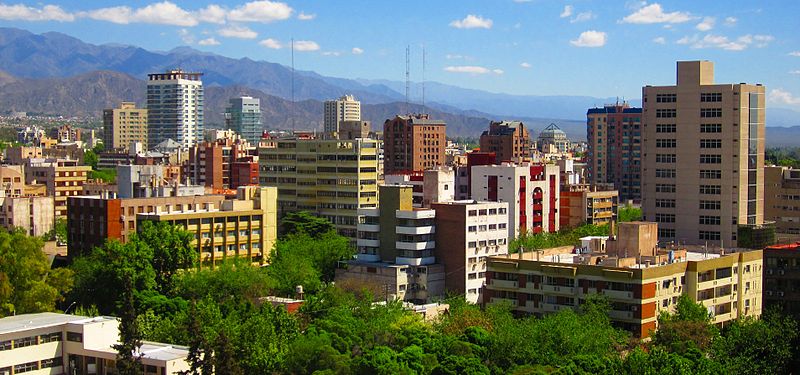
The city of Mendoza, Argentina, is many things: a leafy desert oasis, an important agricultural center, a travel hub, a cultural gem, a wine connoisseur’s paradise, and a base camp for outdoor adventures in the high Andes, to name a few of those things. While the name Mendoza is probably most closely associated with wine, there is something for everyone in this provincial capital.

Mendoza is among the top most-visited cities in the country, along with Buenos Aires and Córdoba, with its wide, tree-lined avenues and relaxing, shade-filled parks being a welcome respite from the crush of humanity in those two megalopolises. The setting is nothing less than spectacular, with the Cordón del Plata towering from the west, behind which looms the highest peak outside of the Himalayas, Cerro Acongagua.

Some who fly into Mendoza might find it hard to believe that they are in a semi-desert climate because of the agreeable greenery and the gurgling fountains. And flying into Mendoza from international destinations via Lima, Peru or Santiago, Chile can be advantageous because the hefty reciprocity fee that is charged to US, Canadian, and Australian passport holders at both of the airports that serve Buenos Aires is not charged here (if you book your bags through at Santiago, you will not be charged the fee in Chile, either). From here, the closest major destination is Santiago, a nine-hour bus trip (allowing two-hours for the border crossing); while within the country, Córdoba is ten hours to the north by bus. So you might as well stick around for a while before heading off again.

Wine tours are what Mendoza is famous for throughout the world. Traditional bodegas (the word used in Argentina for wineries), can be found in nearby Luján and Maipú. Tours range from do-it-yourself bicycle tours that will include a wine tasting, as long as you show genuine interest in making a purchase, to personalized private tours that include gourmet meals. One and a half hours to the southwest is the Valle de Uco, where you will find many innovative, foreign-owned wineries that are moving beyond the famous Malbecs and other wines that are enjoyed by the Argentines, producing world-class blends with a growing number of grape varieties that are new to the region.

If art and culture are your passions, then Mendoza has much to offer. Visits to art and historical museums will be interspersed with pleasant strolls through the beautiful city center with its many plazas (where you are likely to find artists with their easels, capturing the ambiance for posterity); lingering coffee breaks at the numerous cafés (where the people-watching is superb, as long as it is not siesta time); shopping excursions for leather goods or wine (great bargains are to be had); and delicious meals that range from traditional Argentine beef barbecues to modern cuisines (mmmm!).

Then there is the natural splendor of the Andes Mountains to explore. Activities include everything from day hikes to serious mountaineering excursions, rafting to paragliding, fly-fishing to horseback riding, and anything else that you can image the Western Hemisphere’s highest mountains to offer.

All that activity calls for a spa treatment! Termas de Chachueta comprises a network of hot springs that are located just an hour away from the city. The full luxury treatment includes masseuses, Jacuzzis, and more, with a buffet lunch, to boot. Or, you can simply soak in the warm healing waters in a relaxing natural setting.

Back to the city: You will find it to be bustling in the morning and very quiet during the hot afternoon hours of siesta, springing back to life for the evening and into the nighttime, when the youth come out to see and be seen. The dinner hours begin at 8 pm, theater or music shows do not begin until after 10 pm, and the bars and dance clubs are empty until about 1 am, with the party going on into the wee hours.

In order to experience the best of Mendoza, I recommend Posada de Rosas Garden Apartments. My husband and I visited the posada recently and had the chance to sit down and talk to the proprietors, Ellen and Riccardo, over coffee and croissants.

A tour of the grounds revealed three elegant studio apartments, each opening onto a captivating courtyard that includes a lush garden, a romantic terrace, a grape arbor, a very inviting swimming pool, and of course, a parilla, or Argentine barbecue. During the heat of the day, the earthy colors in the sitting area in the residential home at the front of the property was the perfect setting for our little gathering, from where the play of bright sunlight off the patio just outside created the peaceful ambiance of a quiet oasis in the middle of a bustling city.

During out chat, I was even more impressed with the character of Ellen and Riccardo, finding them not only to be very interesting people, but also very professional, very attuned to what travelers need, very informed about the region, very attentive to every little detail, and wonderful hosts. They operate Amazing Mendoza Tours, a highly regarded tour company that offers different kinds of excursions and tours, including cooking classes, visits to artists’ studios, and much more. They very successfully take advantage of the knowledge and skills of a professional travel writer and an artist, with both of them being experienced travelers, themselves.

And if all of that were not enough, well, you know what they say about location (location, location). Posada de Rosas is within easy walking distance of Mendoza’s main square, Plaza Independencia, in one direction and Parque General San Martín, the 420-hectare park that is considered to be one of Mendoza’s highlights in the other direction, as well as the vibrant nightlife center of “Aristedes.”

So when you come to Mendoza, be sure to make bookings and purchase travel tickets well in advance, particularly if it is during the high season, December to March.

[Image of Mendoza via Wikipedia]

Julie R Butler is a writer, journalist, editor, and author of several books, including Nine Months in Uruguay and No Stranger To Strange Lands (click here for more info). She is a contributor to Speakout at Truthout.org, and her current blog is Connectively Speaking.
email: julierbutler [at] yahoo [dot] com, Twitter: @JulieRButler

Barrios (Neighborhoods) of Montevideo

article from December 1, 2011
by Julie R Butler

Montevideo’s history began in 1723, when the Portuguese began to build a fort overlooking Montevideo Bay. But the Spanish would have none of it, sending an expedition from across the Río de la Plata just one month after the project had begun to drive the Portuguese away and settle the area themselves. The port came to rival Buenos Aires, and in 1776, Montevideo became Spain’s main naval base for the South Atlantic.

After fighting for independence from Spain, then fighting for independence from the Junta Grande of Buenos Aires, and then fighting for independence from the Empire of Brazil, Montevideo became the capital of the Eastern Republic of Uruguay in 1828. The fortified walls of the Old City were torn down and the New City was expanded into the barrio (neighborhood) now known as Centro. The going was slow, due to the civil war, during which Montevideo was under siege for eight years. It wasn’t until about 1853 when Montevideo finally began to flourish and grow, with the inauguration of the lovely Teatro Solís, after 15 years of construction, representing the hopes and dreams of this promising time.

The neighborhoods of Barrio Sur and Paloma became the home of many Afro-Uruguayans who were freed from slavery, evolving into an important cultural center for Carnival traditions such as Candombe rhythm and the musical theater of Murga, as well as Uruguayan Tango and other unique cultural treasures.

Aguada and Cordón were among the next barrios to be annexed to the New City. Although this region is filled with beautiful and amazing historical edifices, perhaps the most amazing institution is the colorful Sunday market on calle Tristán Narvaja, established in Cordón in 1870.

Beginning in second half of the 19th century and into the early 20th, Montevideo experienced a tremendous population boom of Europeans immigrants mainly from Spain and Italy but also many Central Europeans, and the city grew by leaps and bounds. New neighborhoods were added, large open spaces such as the Rodó, Prado, and Batlle parks, along with the Estadio Gran Parque Central and the Rambla running along the entire waterfront of Montevideo, were wisely engineered by city planners, greatly enhancing the outdoor environment of the city.

The growth spurt lasted through the two world wars, until stagnation hit in the 1950s, which lead to social problems and the dictatorship that lasted until 1985. The city was sadly neglected during this time; but after democracy was restored, the Uruguayans got to the task of rebuilding their beloved city.

Today, the rejuvenated Montevideo is a city of cafés and restaurants, artisans and antique dealers selling their wares at outdoor markets, fishermen and strollers enjoying an afternoon along the Rambla. The charming Old City and the neighborhoods around it continue to serve as the beating heart of the nation. Bohemian neighborhoods surround bustling universities, while mixed resident and shopping areas that stretch along the waterfront in popular locations such as Pocitos and Punta Carretas along with the more upscale Buceo and Carrasco barrios have a Mediterranean feel.

Throughout the city, the bus system is efficient and easy to use, nothing is all that far away, and the rate of hustle in Montevideo’s bustle is refreshingly laid-back.

[Photo by Jamie Douglas]

Julie R Butler is a writer, journalist, editor, and author of several books, including Nine Months in Uruguay and No Stranger To Strange Lands (click here for more info). She is a contributor to Speakout at Truthout.org, and her current blog is Connectively Speaking.
email: julierbutler [at] yahoo [dot] com, Twitter: @JulieRButler

Florianópolis, Brazil’s Own “Punta del Este”

article from November 15, 2011
By Jamie Douglas

Just 500 miles north of the Uruguayan border with Brazil lies Florianópolis, the capital of Santa Catarina state, a lovely seaside city of 420,000 inhabitants that is often cited as one of the most livable cities in all of Brazil. Although this very cosmopolitan city is located almost 28 degrees south of the equator and 4.5 degrees below the Tropic of Capricorn, it is still the blessed recipient of a tropical climate.

Florianópolis is split between the mainland and Ilha de Santa Catarina. The island is connected to the mainland by three bridges, one of which is now only a monument. After opening to the public 85 years ago, it took 50 years to repay the bankers for the loans to build that bridge.

The majority of the population lives on the central and northern part of the island and the in continental portion. In 2006, Newsweek listed Florianópolis among the ten most dynamic cities in the world, while an article in The New York Times called it the party destination for 2009. Brazilians agree that it is, indeed, the best place to live in Brazil. With 42 beaches and world-class surf, it is easy to see why so many people from São Paulo and Argentina maintain vacation homes here. And with its attractive beaches, it is little wonder that tourism is the number-one industry, closely followed by several high-tech companies that thrive in the academic environment provided by several institutes of higher learning, including the renowned Federal University.

Florianópolis is not just beaches. It has been around for several hundred years, having originally been settled about 4,000 years ago by the Tupi people. They are believed to be the original inhabitants of Amazonia; but about 5,000 years ago, they migrated south, gradually spreading along what we know of today as the Brazilian Atlantic coast. They were the primary residents of the region, with a population of about one million when the Portuguese arrived. The Portuguese founded a ships’ chandlery at Florianópolis in 1514 that did not merit the title of an official village until 1714, when the Portuguese Crown elevated the island to that status.

The city today is home to many festivals, and this being Brazil, Carnival is one of the largest, along with Easter Week and the Holy Spirit Feast that takes place 40 days after Easter, with religious parades, street festivities and, of course, ethnic foods.

The center of the old city, commonly referred to as Floripa, has many fine old colonial buildings, churches and museums that are well worth a visit. Don’t miss the excellent public market that dates back to 1898, where you will find food and drink as well as assorted handicrafts that clearly show the Azorean roots of the early settlers of the island.

Reputedly, the city is relatively safe to wander about, but caution is always advised when gallivanting about at night, particularly after imbibing some of Brazil’s strong distillates.

Enjoy the nightlife and the beaches. They are second to none.

Jamie Douglas
San Rafael, Mendoza

[Image of Florianópolis via Wikipedia]

I encourage you to write me at cruzansailor [at] gmail [dot] com with any questions or suggestions you may have. Disclaimer: I am not in any travel-related business. My advice is based on my own experiences and is free of charge (Donations welcome). It is always my pleasure to act as a beneficial counselor to those who are seekers of the next adventure.